Tag: Home Appliances

  • [2026 Winter Guide] Dry Air in Japanese Apartments? Top 4 Mold-Free & Easy-to-Clean Humidifiers for Expats

    [2026 Winter Guide] Dry Air in Japanese Apartments? Top 4 Mold-Free & Easy-to-Clean Humidifiers for Expats

    Waking up in Japan with a scratchy throat, dry skin, or sudden winter chills?

    Japanese winters bring notoriously dry air. Once you turn on your apartment’s A/C heater, indoor humidity drops drastically to 20%–30%. This doesn’t just cause discomfort—it creates a breeding ground for flu viruses and dust mites. To keep your home comfortable, hygienic, and aligned with Japanese Seiketsukan (cleanliness culture), securing a proper humidifier before peak winter hits is absolute essential.

    1. Why Japanese A/C Heating Dries Out Your Apartment So Fast

    In most standard Japanese rental apartments (1R/1K/1LDK), kerosene heaters are strictly prohibited due to fire safety regulations. As a result, almost every expat relies entirely on wall-mounted Air Conditioners (A/C) for winter heating.

    However, A/C heat pumps continuously blow warm, dry air into a compact space, causing indoor moisture to vanish within hours. When humidity drops below 40%, you face three major lifestyle pain points:

    • Respiratory Irritation: Dry mucous membranes make your throat vulnerable to airborne colds and viruses.
    • Lower Perceived Temperature: Dry air makes 22°C feel much colder, forcing you to crank up the heater and inflate your electricity bill.
    • Skin Desiccation & Static Shock: Persistent dry skin and annoying static electricity on winter clothing.

    Maintaining an optimal 50%–60% humidity level keeps you warm, healthy, and energy-efficient throughout the Japanese winter.

    2. The Expat Trap: Buying cheap humidifiers can lead to mold and bacterial mist!

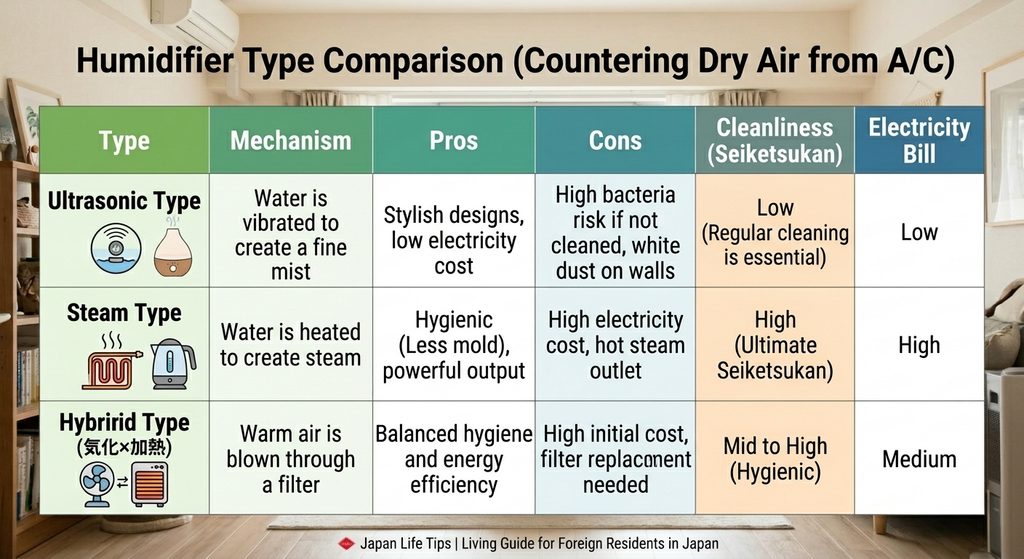
    When shopping on Rakuten or Amazon, it’s tempting to grab the cheapest or most aesthetic desktop mister. But beware: humidifiers come in 3 primary types (Ultrasonic, Steam/Heating, and Hybrid), and choosing the wrong one can turn your room into a damp, moldy disaster.

    Unheated Ultrasonic humidifiers, if not scrubbed religiously, breed bacteria inside the water tank—literally spraying germs into your air. True Seiketsukan means choosing a unit that warms or boils water to eliminate microbes effortlessly.

    👇 Check out the comparison table below to find the ideal humidifier type for your lifestyle!
    3. Top 4 Mold-Free & Easy-to-Clean Humidifiers on Rakuten

    Here are the best-performing models in Japan, tailored for expat apartments with hassle-free maintenance and top-tier hygiene.

    Ultimate Hygiene (Zero Mold Risk)

    1. Zojirushi Steam Humidifier (EE-DE50DS) – Boiling Pure Steam & Zero Filter Hassle

    The undisputed holy grail of humidifiers in Japan. It works like an electric kettle—boiling water to produce 100% sterile, warm steam that instantly hydrates your room. No filters to replace, no slimy tanks. Just open the wide pot-like lid and wipe it down. If you want maximum Seiketsukan and effortless maintenance, this is the absolute #1 choice.

    Compact & Budget Steam Option

    2. Iris Ohyama Compact Heating Humidifier (AHM-H12B) – Ideal for Desks & Bedside

    Looking for the safety and hygiene of heated steam on a tight budget? This compact 1.3L unit from Iris Ohyama runs continuously for up to 11 hours. It fits neatly on small bedside tables or work desks and features an essential oil tray for relaxing aromatherapy.

    Top Seller & Energy Efficient

    3. 4L Top-Fill Ultrasonic Aroma Humidifier – Large Capacity & Low Electricity Cost

    Rakuten’s #1 best-selling ultrasonic unit. Features a convenient top-pour design so you don’t have to carry heavy water tanks to the sink. Ultra-quiet with soft LED lighting and aroma diffuser capabilities. Highly recommended if you want maximum capacity and ultra-low energy consumption (just remember to give it a quick weekly clean!).

    Powerful Performance & Modern Design

    4. Iris Ohyama Wood-Grain Hybrid Humidifier (PH-UH35) – Rapid Hydration & Energy Smart

    Combines heated vapor with ultrasonic misting for fast, whisper-quiet humidification. Designed with stylish wood-grain aesthetics that elevate any modern living space. Runs continuously for 12 hours while keeping electricity costs under control.

    4. Conclusion: Protect Your Health & Comfort Before Peak Winter

    Don’t wait until you’re suffering from a sore throat or dry skin to start looking for solutions. Equipping your home with the right humidifier before freezing temperatures arrive guarantees a warm, hygienic, and relaxing winter in Japan.

  • How to Use a Japanese Rice Cooker: Buttons, Translation, & Best Models for Expats

    How to Use a Japanese Rice Cooker: Buttons, Translation, & Best Models for Expats

    When starting your new life in Japan, one of the most essential home appliances you will need is a Japanese Rice Cooker (Suihanki).

    However, using one for the first time can be tricky:
    “The buttons are all in Kanji and I don’t know what they mean…”
    “What does ‘Go (合)’ mean?”
    “Which type should I buy?”

    This ultimate guide covers multilingual translations for operation buttons (English, Vietnamese, Indonesian), explains the “Go” measurement standard, recommends the best rice cookers for expats, and shares freezer-storage hacks to save on electricity bills!

    1. Top 3 Best Rice Cookers in Japan (By Purpose & Budget)

    Choosing the right rice cooker depends on your living style (living alone vs. living in a share house). If you live with roommates, splitting the cost makes high-end models surprisingly affordable!

    ① Best Budget Pick for Singles: Iris Ohyama (3-Cup Capacity)

    • Recommended for: International students living alone or anyone looking to minimize initial moving costs.
    • Features: A simple, compact, and affordable model. It costs under 7,000 yen, making it a great entry-level choice.
    Iris Ohyama Rice Cooker

    Iris Ohyama Rice Cooker 3-Cup (Microcomputer Type)
    Price: Approx. 6,980 JPY (Tax included, Free shipping)

    ② Best Value & Quality: Tiger IH Rice Cooker (5.5-Cup / Made in Japan)

    • Cost Split Idea: ~5,930 JPY per person for 3 people / ~4,450 JPY for 4 people
    • Recommended for: People living in a share house (2–4 people) or those who want delicious fluffy rice.
    • Features: A trusted Made in Japan model from Tiger! Uses high-power Induction Heating (IH) to cook rice to perfection. Highly recommended for splitting costs with housemates.
    Tiger IH Rice Cooker

    Tiger IH Rice Cooker 5.5-Cup Black JPW-H100 K
    Price: 17,800 JPY (Tax included, Free shipping)

    ③ Premium Quality: Zojirushi IH Rice Cooker (5.5-Cup / Kimedaki)

    • Cost Split Idea: ~7,450 JPY per person for 4 people
    • Recommended for: Foodies who want the absolute best taste and texture from Japanese rice.
    • Features: Zojirushi’s high-heat IH model. Delivers exceptionally sweet and chewy rice.
    Zojirushi IH Rice Cooker

    Zojirushi IH Rice Cooker NW-QA10-BA Black
    Price: 29,800 JPY (Tax included, Free shipping)

    2. Rice Cooker Button Translation & How to Use

    Japanese rice cookers look intimidating with all the Kanji, but you only need to remember a few basic buttons!

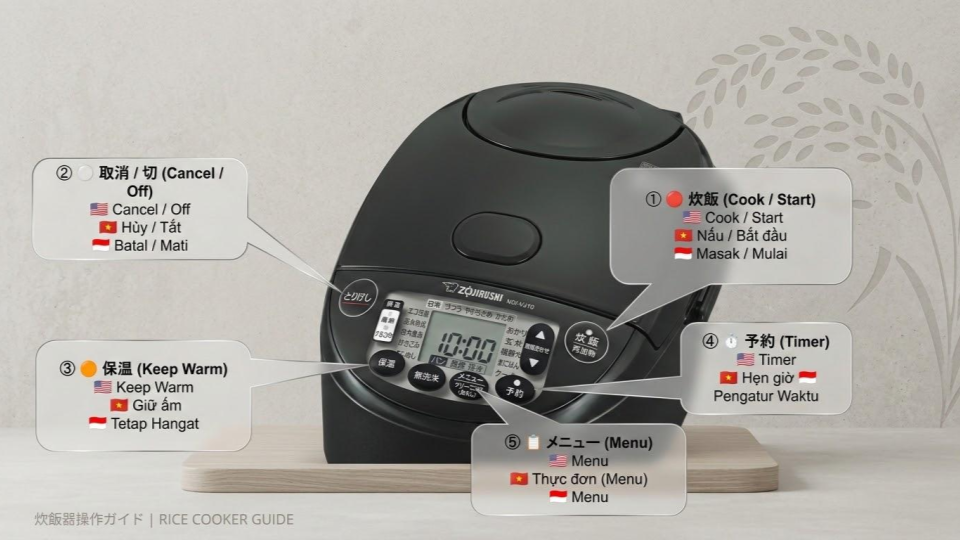
    Japanese rice cooker panel translation English Vietnamese Indonesian
    Multilingual Translation Guide for Rice Cooker Operation Panels

    Rice Cooker Button Glossary

    Japanese English Tiếng Việt (Vietnamese) Bahasa Indonesia
    炊飯 (Cook) Start / Cook Nấu cơm Memasak
    保温 (Keep Warm) Keep Warm Giữ ấm Menghangatkan
    取消 / 切 (Cancel) Cancel / Off Hủy / Tắt Batal / Mati
    予約 (Timer) Timer / Schedule Hẹn giờ Pengatur waktu
    早炊き (Quick) Quick Cook Nấu nhanh Memasak nhanh
    エコ炊き (Eco) Eco Cook Nấu tiết kiệm Memasak hemat
    無洗米 (No-wash) No-wash Rice Gạo không cần vo Beras tanpa cuci
    おかゆ (Porridge) Porridge Cháo Bubur
    玄米 (Brown Rice) Brown Rice Gạo lứt Beras merah

    What is “Go (合)”? Rice Measurement Guide

    The unit “Go (合)” used in Japanese rice cookers and measuring cups often confuses foreigners. Keep these standards in mind:

    • 1 Go (1合) = Approx. 150g (About 2 bowls of cooked rice)
    • 3-Cup Cooker (3合炊き) = Ideal for 1–2 people
    • 5.5-Cup Cooker (5.5合炊き) = Ideal for 3–4 people or meal-prepping

    3. Save Money & Time with Meal-Prepping & Freezer Storage!

    Cooking small amounts of rice every single day wastes both electricity and time.

    The best life hack is to cook a large batch using a 5.5-cup rice cooker, portion it out, and store it in the freezer using special containers!

    Tips for Freezing Rice to Keep It Delicious

    1. While the rice is still hot, put it into individual container portions.
    2. Let it cool down, then place it in the freezer.
    3. When you want to eat, microwave it with the lid on for about 2.5 to 3 minutes (600W)!

    Using dedicated rice freezing containers prevents the rice from getting squished and keeps it tasting just as fluffy as freshly cooked rice!

    Recommended Rice Freezer Containers (Set of 5)

    Eco-friendly, reusable without plastic wrap, and microwave-safe—an absolute must-have for living alone or in a share house.

    Rice Freezer Containers

    Rice Freezer Storage Containers (Set of 5)
    Price: 656 JPY (Tax included, Free shipping)

    Summary

    With the right choice of rice cooker and a few smart storage habits, you can enjoy delicious, affordable rice every day in Japan.

    • Living Alone? = 3-Cup Cooker (Keep initial costs low!)
    • Share House / Meal Prep? = 5.5-Cup IH Cooker (Split costs and get a better model!)
    • Cooked in Bulk? = Freeze in special containers to save on electricity!

    Choose the best rice cooker for your lifestyle and start your comfortable life in Japan! If you know any friends struggling with their appliances, feel free to share this guide with them!